Alkmaar, The Nederlands. March, 2021. Let's buy more stuff.
So, a resin printer needs resin to be able to print things. That stands to reason. But what else is also needed?
Whoah, hang on a minute. Take a step back. Choosing the resin printer is only one step. Now you have to decide which resin to use. Yes, there's more than one. There's the standard resin, ABS resin, water washable resin, bio-resin, to name just a few types. And these are types, not makes.
More reading. More watching videos. More overthinking.
Right, let's go with this Elegoo ABS resin in beige. I did want grey but Amazon didn't have it in stock in the 500g bottle and I didn't want to buy a big bottle in case the stuff was crap.
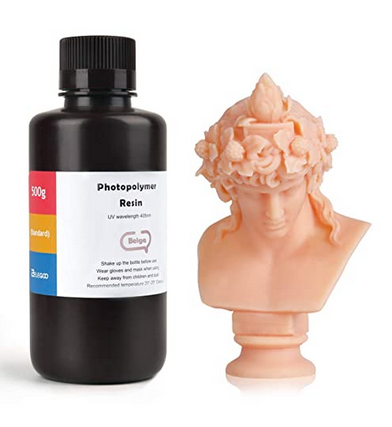
This looks like it produces nice results and the reviews are mostly favourable.
One of the big issues with resin printers is ... the resin. It's toxic, can stink and is difficult to clean up needing special precautions. So, I had to invest in a couple of bottles (5 litres) of IPA (99%) to clean the prints, a box of nitrile gloves to handle the resin, prints and tools and some masks to prevent breathing in the resin fumes. All while these items have become bloody expensive due to the corona pandemic.
I needed some flexible silicon mats to place in front of the printer to allow the build plate, tools etc. to stand on and still be easy to clean up if any resin spills on them. A couple of hard plastic dinner trays to hold the tools. Some airtight containers to hold the IPA after it's been used. And while I'm at it I may as well get a cleaning and curing station.
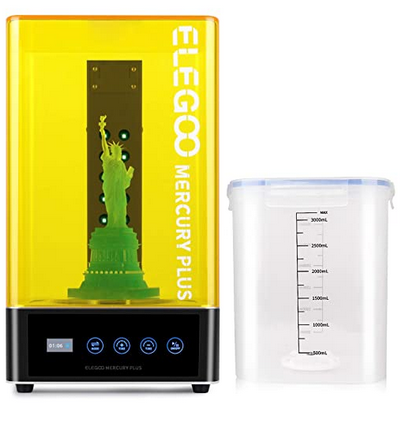
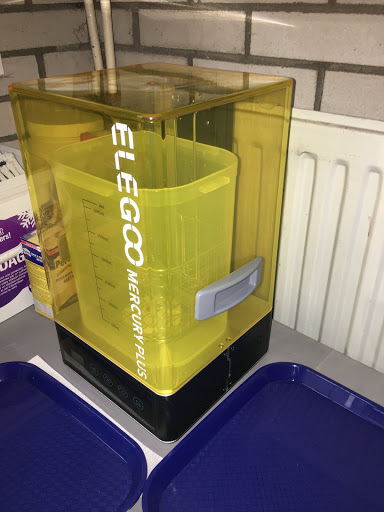
The Mercury wash and cure station will wash the prints and when they've dried it will cure the resin so that it's no longer toxic. The big plastic container has a rotor on the bottom which whips the cleaning liquid up so that it gets everywhere on the printed models. You can place the whole build plate in there, or put the individual models into a basket. This bucket is then taken off and replaced with a little turntable onto which the un-cured models are placed. The lights then cure the model properly. Quick and easy.
Not knowing how bad the resin would smell I also invested in a couple of Elegoo Air Filters. These are small enough to be able to fit inside the printer. They use activated carbon filters, which replacements are available for, and are charged with a USB cable.
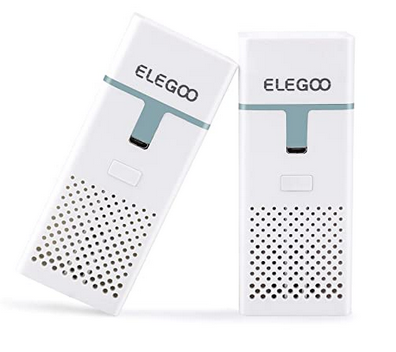
Let's get rid of any smell. Not just resin, but also IPA. One inside the printer casing, one on a shelf above the workstation.
That's about everything. Oh, apart from a spray bottle, airtight food containers, safety glasses, lots of paper kitchen rolls and bin liners to throw all the resin contaminated crap into, a funnel and some coffee filters to filter resin from the vat back into the bottle.
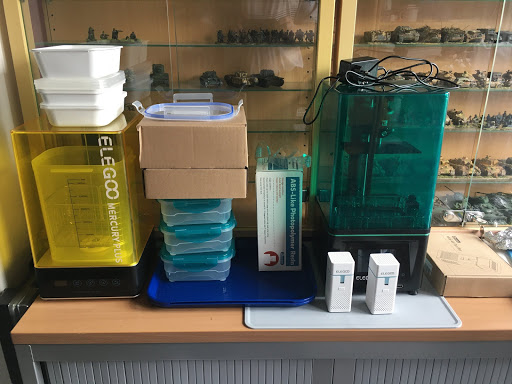
I also make use of old takeaway containers as a place to hold models and also wash them in warm water to make support removal easier.
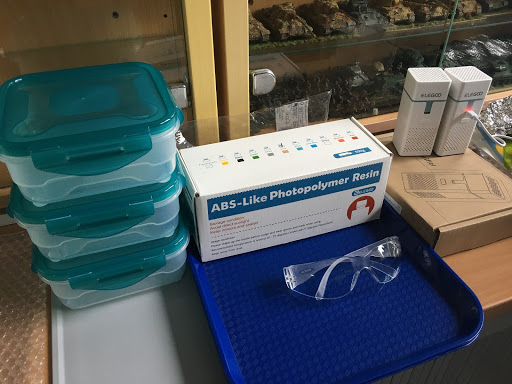
The safety glasses are to stop any splashes going in my eyes or any bits of resin flying into my eyes when removing supports.
I also bought some stick-on handles to put on the sides of the two lids in order to make it easier to lift them on and off.
Given the amount of other equipment I'd acquired, it made sense to set the printer up in the garage. This meant I had to clean up the area on the workbench and the shelving above it. What I thought would be a few hours turned into a couple of days. I had to make some extra shelving just to hold all the paraphernalia for printing. But, eventually, it was ready ... except the nitrile gloves hadn't arrived in time.
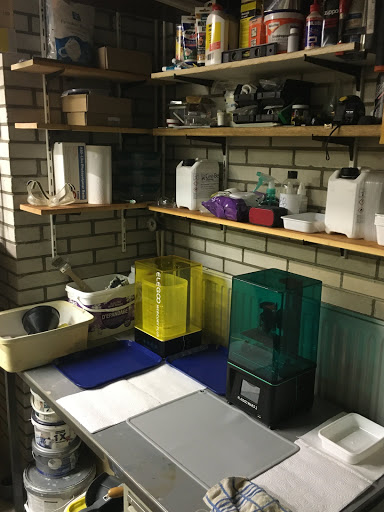
My initial setup once everything bar the nitrile gloves had arrived.